
Marines Vietnam War Geneva, IL Flight date: 07/29/26
By Mark Splitstone, Honor Flight Chicago Veteran Interview Volunteer
Keith Howard had been serving at Marine Corps Air Station Iwakuni in Japan for several months when he received orders to board a plane, although he wasn’t told the destination. The plane eventually landed in a remote jungle, with a small base consisting of nothing but a runway, a taxiway, and a few wooden buildings. He still didn’t know what country he was in, much less what this sad imitation of an airfield was, and he wouldn’t find out for several weeks. In fact, it was a highly classified facility in Thailand that Keith and other Marines were tasked with converting into a base for Marine Corps air operations. They soon gave it the nickname “The Rose Garden.”
Keith was born in Fort Worth, Texas, in 1948. His family moved around a bit while he was growing up, and he eventually spent his high school years in St. Louis. His father was an electrician who, for much of his career, worked for defense contractors, including Convair, General Dynamics, and McDonnell Douglas. Keith recalls being instilled with a great sense of patriotism from a young age, leading him to make his first major life decision when he was a senior in high school. The Vietnam War was heating up, and while he didn’t necessarily want to fight in a war, he did want to serve his country. He decided that he wanted to be a Marine, and recalls that in April 1966, on the night before his 18th birthday, he watched the John Wayne movie “The Sands of Iwo Jima.” The next day, he went to the Marine Corps recruiting office and enlisted for a four-year term.
After eight weeks of boot camp at MCRD San Diego and two weeks of Infantry Training Regiment, he was assigned to his first duty station, the Naval Air Technical Training Center in Millington, Tennessee. There, he attended electronics school and avionics school, learning how to repair electronics on aircraft, primarily the A6 and F4. After several months there, he was assigned to an F4 squadron at the Beaufort, South Carolina, Marine Corps Air Station. His next stop was Naval Air Station Glynco in Georgia. This had been the home of the Navy’s blimps during World War II, but by the late 1960s, it was the Navy’s center for radar training. Keith learned about the different radars that the Marines were using at the time, and also Marine Air Traffic Control Units (MATCUs). This expertise would occupy him throughout the rest of his service in the Marines.
By 1969, Keith had served for three and a half years, had enjoyed it, and decided to reenlist. He knew the Marines were offering a variable reenlistment bonus, and went to his sergeant major to discuss this option. Rather than the bonus, the sergeant major recommended that Keith enroll in the Naval Enlisted Science Education Program (NESEP). This program allowed enlisted men to study science at universities while still on active duty, and after receiving their degree, they’d graduate as officers. This sounded great to Keith, so he signed up, and before long, he was enrolled as an electrical engineering student at the University of Colorado at Boulder. Given the unrest on college campuses, his years there were often uncomfortable, particularly because the men in the NESEP program were required to wear their uniforms one day a week. He planned to be there for four years, but after two years, the Marines informed him that his MATCU expertise was needed in Japan. He left the Boulder campus as a sergeant in 1971 and wouldn’t go back to college for almost 30 years.
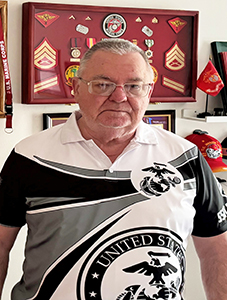
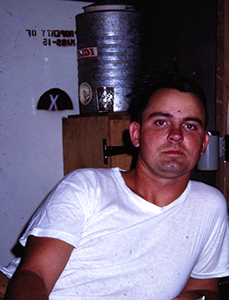
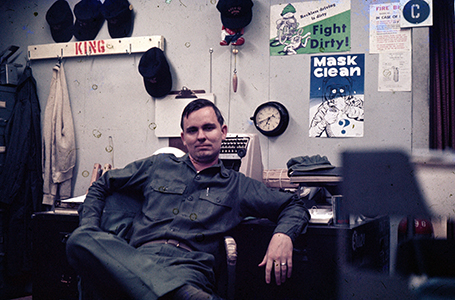
His stay in Japan was destined to be short, and before he knew it, he was in the middle of the jungle in Thailand in a place called Nam Phong. The base had an interesting backstory. Although an airstrip had been constructed there in 1967, it was never really used as an airfield, and instead was used as a camp to train Thai and Laotian counterinsurgents. That’s what it remained until 1972, when the combination of a military crisis and a political problem completely changed its purpose. The North Vietnamese had launched what came to be known as the Easter Offensive, but since the United States was drawing down its forces in Vietnam, it was constrained in what it could do to help. In particular, for political purposes, they didn’t want to send air assets back to their base in Da Nang. Their air bases in Thailand were at capacity, but someone remembered the unused airstrip at Nam Phong. In the blink of an eye, “Task Force Delta” was formed, and Keith and a band of Seabees and Marines were sent to Nam Phong to create a fully functioning air base in the middle of the jungle as quickly as possible. Since Keith’s MATCU unit was a prerequisite for successful flight operations, it was one of the first teams to arrive, and what they discovered looked nothing like a typical Marine air base. It lacked latrines, showers, and a mess hall, and initially everyone slept in tents. At the time, there was a popular song called “I Never Promised You a Rose Garden,” and the Marines at Nam Phong started using that as the nickname for their new home. The name stuck.
For three weeks, they worked day and night, battling heat, primitive conditions, bugs, and snakes, and created an air base. The Seabees and Marines cleared jungle, fortified the runway, and constructed latrines, hooches, and support buildings. Keith and his team set up the necessary controls to turn it into a functioning air base. Before long, Marine squadrons from Da Nang were transferred to Nam Phong, and they were soon flying missions to Vietnam. The Nam Phong base was soon a 24/7 operation, with mostly A6 and F4 squadrons flying regular sorties. They were able to make the base more livable, and in Keith’s hooch, they even retrieved a drag chute and hung it from the ceiling for decoration. The base remained in operation until the middle of 1973, and when the final men of Task Force Delta departed, they became the last Marine combat force to stand down and leave the Vietnam War theater.
In 1973, after ten months at the Rose Garden, Keith was transferred back to the United States and assigned to Marine Corps Air Station New River in Jacksonville, North Carolina. This was the primary training and deployment hub for Marine helicopter and support squadrons. He was stationed there for two years, and since he was still enjoying being a Marine, he considered re-enlisting. However, his wife at the time had had enough of being a military wife, and she encouraged him to leave the service. So in 1975, he left the Marines and returned to St. Louis. His first job after the Marines was with Rockwell, but he’d go on to work in various operational roles at a wide variety of firms, from Frito-Lay to Switzer Candy to Honeywell, and his career has taken him from St. Louis to North Carolina and finally to the Chicago suburbs.
Early in his career as a Marine, at age 19, Keith met and married a woman from St. Louis, and they would go on to have two children while he was still in the Marines. They later divorced, and Keith went on to marry his second wife, Nancy. They’ve now been married for nearly fifty years, and between them they have four children and eight grandsons. In his retirement, Keith enjoys constructing 3D wooden models, but his main love is spending time with his grandsons, three of whom live in the area. Long after being told by the Marines that his time in college was over, he eventually did go back, completing his degree and graduating at age fifty.
After completing his service, Keith kept in touch with several of his Marine buddies and even participated in some Marine organizations, but over the years, these contacts have mostly slipped away. He had been put in an awkward position because he had been told that Rose Garden was a secret operation, and for a long time he didn’t know if he was allowed to talk about it. He’d often just tell people that he served in “Southeast Asia” and leave it at that. Once he discovered that it was no longer secret, he joined some online groups focused on this fascinating mission, and he proudly displays Task Force Delta memorabilia on his wall. To date, he hasn’t been able to connect with any of the friends he met there, but he hopes to do so in the future. He was thrilled when he discovered that his daughter-in-law had applied to Honor Flight on his behalf and gave it to him as a gift. While he’s not sure what to expect, he’s excited and is looking forward to reconnecting with other veterans on his flight.