
Coast Guard Vietnam War Chicago, IL Flight date: 07/29/26
By Christina Nichols, Honor Flight Chicago Veteran Interview Volunteer
Reginald (Reggie) Jones, a proud Chicagoan and the youngest of five children, proudly served our country all over the globe, in places most people could never imagine having the opportunity to visit. Long before his dedicated service, Reggie’s grandfather registered for the draft, in 1916, during WWI, but he was never called to duty. Several decades later, other members of Reggie’s family bravely served our country during WWII. For example, his eldest brother, 25 years his senior, served in the Navy, and Reggie’s uncle served in the Army, including in France, after D-Day. Reggie’s life in the military, on the other hand, started in Chicago, in 1970, when he thought about joining the reserves.
How he came to this decision is that Reggie, at this time, was in his second year of college and was unsure of what he wanted to do with his life and what career he wanted to pursue. Reggie was also working nights for Time Magazine while in college, and, on one fateful night after leaving work, he took the bus home and bumped into a buddy with whom he had gone to high school. This friend mentioned that he was in the military, working on the Chicago River on buoy tender. Reggie’s buddy said that his work routine entailed being stationed on the river every fourth day after three days at home. What immediately came to Reggie’s mind is the profound sadness he felt when thinking about four of his former high school classmates who had died in Vietnam in 1969. In contrast, this old friend from high school was also serving our country yet was not directly in harm’s way. So, in April of 1970, Reggie made a trip to visit the local Coast Guard recruiter in Niles who informed him there was no opening for the reserves.
Notwithstanding that, Reggie took the test to enter and passed. By December of that year, when Reggie “lost his deferment” from college, he decided to join the Coast Guard and did so on February 8, 1971. There was a reason Reggie joined on this specific date. He had been informed by the Coast Guard recruiter that the only way to not end up in Vietnam, once Reggie had “received the famous letter from the President of the United States to report to the Army” on January 25, 1971, was to make sure that Reggie enlisted in the Coast Guard prior to his given Army induction date; in Reggie’s case, that date was February 10, 1971.
Now that Reggie had joined the Coast Guard, his first command was to leave for boot camp in Cape May, NJ, where he remained until April 1971. He then returned home, on leave, to spend four months at Hospital Corpsman Training in Great Lakes, IL. Reggie opted to do this additional training after boot camp because he knew he wanted to acquire skills that would be useful in his life after the military. By September 1971, Reggie’s additional training was complete, and he was then transferred to the Coast Guard Academy in New London, CT. Reggie finished his extended medical clinical training in CT by the end of October.
At that time, Reggie learned some more good news: he had been granted an additional assignment in Mobile, AL, the city which he had put on the top of his “wish list.” The reason Reggie selected Mobile was because Reggie wanted to be trained as an Air Crewman, particularly for helicopters, at the aviation training center down in AL. In addition to looking forward to serving our country from sea, as well as high in the sky, Reggie had the benefit that, due to this additional training, his pay rose from just under $200/month for his hospital-related duties to $300/month. On top of that, Reggie received an additional $100/month if he flew at least four hours/month, which brought his monthly salary to $400/month (or double what he had previously been making).
Between the end of 1971 and June of 1972, Reggie’s time in the service included working on various flight assignments along with working in the lab, pharmacy, and triage, helping with whatever needed to be done. In the summer of 1972, Reggie left for his first deployment as part of a “deployable air group,” consisting of 15 people. This entailed Reggie leaving Mobile, driving home to Chicago where he left his car, and then his family dropping him off in Milwaukee.
From there, Reggie went on a Coast Guard ship, an ice breaker, up the St. Lawrence Seaway to Halifax, the capital of Nova Scotia, Canada. The ship refueled in Halifax and headed to what was formerly referred to as Thule Air Base, located on the northwestern coast of Greenland, roughly 750 miles north of the Arctic Circle. In fact, around two-thirds of Greenland, the world’s largest island, is in this polar region. In 2019, the Air Force transferred Thule Air Base to the U.S. Space Force, and, in 2023, its name was officially changed to Pituffik Space Base to honor local cultural heritage.
Reggie’s assignment involved working for three months to open the resupply channels, so that ships passing through the area would not get bogged down in ice. Looking back at the time he spent doing this unique and challenging work, Reggie recalls, “It was a new experience, trust me!” Reggie and the rest of his fellow servicemen completed their work in September 1972. However, just two months later, in November, Reggie was assigned to another deployment; this time, he was told he was leaving out of Long Beach, CA.
So, Reggie reported for duty in CA in the fall of 1972 and left on another Coast Guard ice breaker ship. They made two stops to refuel; this time, first, in Tahiti and, second, in Wellington, New Zealand. Afterwards, they traveled down to the Ross Sea, a deep bay that is part of the Southern Ocean in Antarctica. Reggie recalls that in this particular area, the ice breaker does not stop, rather it just keeps moving for two to three days straight, “going through the flow, breaking the ice,” until they reached their destination in the ocean. The ship stopped around 100 yards from McMurdo Station, the biggest scientific research center and logistics facility in Antarctica, located on the southerly tip of Ross Island in the Ross Sea; it is not accessible by boat, rather only by helicopter.
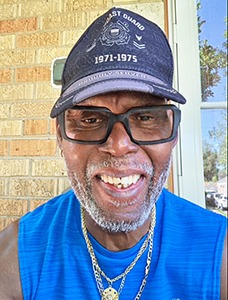
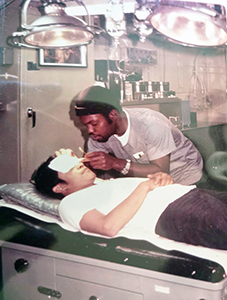
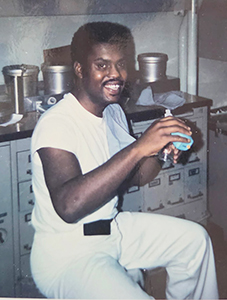
Reggie’s assignment entailed working as a medic on board the ship, tending to the medical needs of those on board. However, he explained that the ice breaker ship he was on was not alone in the Ross Sea; rather, it was one of two ships, located around 200 feet from one another, working together to break the ice apart, thanks to the reinforced and rounded hulls of the ship which slid on top of the ice and then forcefully came back down to break it apart.
In addition to his medic work on board ship, Reggie also worked as an air crewman. His work included flying to McMurdo Station, retrieving the mail that had been delivered there, and bringing it back to the ship, since mail had not been retrieved in over a month.
By Christmas 1972, the job of clearing the supply chain was done, so Reggie and the rest of the deployable air group departed, with scientists on board, to circumnavigate the South Pole, doing so right above the ice caps. The journey lasted 35 days!
Before returning to California, the ship stopped in Valparaiso, Chile, which was the first sign of civilization they had all seen in a long time. They remained in Chile for three days, refueled, and new supplies were flown in for them. Their next stops were Lima, Peru, and Mazatlán, Mexico, where they refueled each time. One week after leaving Mexico, Reggie and the rest of the crew returned to Long Beach in April 1973.
At that time, Reggie headed back home to Chicago, where he enjoyed five days of leave with his family. After that, he picked his car up and drove from Chicago to Indiana, where Highway 65 begins, and then drove 900 miles straight down to Mobile, AL. Reggie was only in Mobile for two months when, in June 1973, he came back to Milwaukee to leave for his next deployment.
Reggie remained in Wisconsin for five days before being deployed on another ice breaker ship. This time, Reggie traveled north to refuel in both Halifax, Nova Scotia, and Greenland. However, unlike the last time Reggie traveled to this area, he and his fellow servicemen now went to Reykjavík, Iceland, where they refueled a third time, before arriving in Keflavik, Iceland. Their job was to, once again, open the resupply chain in the frigid North Atlantic Ocean, in an area that was eight hours away from Keflavik by boat.
It was an unbelievable coincidence that, at this same time, coincidentally, peace talks were happening in Keflavik between the U.S. and Iceland. The talks were happening because the Icelandic Defense Force wanted to take over the military base there. By the end of the negotiations, there was a reduction in American troops in Keflavik, and Iceland, in turn, remained in NATO.
Reggie’s ice breaker ship left earlier than expected from Iceland because war broke out in Israel in the fall of 1973, at which time the military ordered all ships that were not in vital missions to come back to the United States as quickly as possible. Therefore, Reggie returned home by September 1973, after making the return voyage through Halifax, then passing Montreal on their journey down the St. Lawrence River, before arriving at their destination in Milwaukee.
Reggie went back to Mobile for two months, until November 1973, before being deployed again out of Long Beach, CA. From there, Reggie left for Pearl Harbor, Hawaii, where he trained for two weeks, before departing to three cities in New Zealand: Auckland, Wellington, and Christ Church. After leaving New Zealand, Reggie arrived in McMurdo Naval Station where he, and his fellow servicemen, once again, opened the resupply chain by breaking ice there.
After two weeks, their job was done. Reggie and the crew left with scientists, once again, on another journey circumnavigating the South Pole. Months later, in the spring of 1975, Reggie left up north, stopping, first, in Wellington to refuel, as well as Punta Arenas, Chile, one of the most southerly cities in South America, before heading straight home to Long Beach, where he arrived in March 1974. Reggie left from CA to Mobile, where he finished his time in the service in February 1975, when he was released from active duty.
Over the course of the last 50 years, Reggie has been very busy in his professional career, all of which has been within the healthcare realm. First, while Reggie went back to college at Chicago State University, he worked as an EMT for several years. After earning his bachelor’s degree in chemistry, in 1981, he moved to New Orleans, where he worked again as an EMT, until 1984. At that point, Reggie moved back to Chicago and began his career in pharmaceuticals, which he remained in until his retirement in 2017. He worked in both the Cook County and University of Chicago Hospital systems, within the pharmacy department.
On a personal note, Reggie got married in 1991 and has one son who chose to follow in Reggie’s footsteps by joining the military. Reggie’s son joined the Illinois National Guard in 2011 and, last year, in January 2025, he left for his first, long-term, overseas assignment. Prior to that, Reggie’s son had spent a month, or so, in various areas of the world, but never had left for a long-term assignment. Reggie’s son was stationed halfway between Saudia Arabia and Yemen, for eleven months, and returned home in December 2025, shortly before the war started. He saw rounds being shot back and forth overhead, during his time abroad, so returning home took some readjustment. Reggie’s son chose to stay with Reggie for a while so that he could have someone to talk to about all he had witnessed while overseas.
Looking back at his time in the military, Reggie is very grateful that the service provided him with not just a way to direct his focus and energies at a pivotal time in his life when he was unsure what he wanted to do, but also that he was able to learn so many useful skills that were necessary to pursue his fifty-year-long career in the healthcare field! Additionally, Reggie is very appreciative that, during the time he served, he was able to travel to so many places in the world that most people can only dream of visiting. However, it is each and every American that owes a debt of gratitude to Reggie, and all the men and women who serve in the military, for all they bravely, and selflessly, do in service to our country!