
Army Vietnam War Bloomingdale, IL Flight date: 04/15/26
By Charlie Souhrada, Honor Flight Chicago Veteran Interview Volunteer
Brandt Leischner was born in 1947 on Chicago’s north side in a predominantly German neighborhood near Damen and Addison, just over a mile from Wrigley Field. His parents, Terrance and Anna, married during Terrance’s WWII Navy service and started their family after the war.
Brandt remembers his Baby Boomer childhood fondly: “My parents saw to it that my sister Pamela and I ate and dressed well, attended good schools and enjoyed annual family vacations planned around my father’s love of fishing.”
Growing up in the 1950s, he recalls fewer cars, open fields, and endless opportunities for play. He and his friends, some of whom he still calls “the old gang,” spent their days inventing games, riding bikes, and playing softball in the streets. Nearby vacant lots, including the future site of the WGN-TV studios, where his mother later worked, became their wilderness playground for building forts, catching garter snakes, and swinging on a rope hung from a large tree.
Brandt attended Luther High School North, graduating in 1965. After an unsuccessful attempt at college in Nebraska, he pursued his early interest in aviation. “I wasn’t the kind of person for academics but give me a wrench and something to fix, that’s my thing.” He enrolled at Parks Air College in Cahokia Ill., completing a rigorous 13-month program and earning his Airframe and Powerplant certificate in 1968.
He was hired by TWA at O’Hare that same year but soon lost his student deferment and faced the draft. Senior mechanics advised him to visit the draft board and request a six-month delay so he could complete his probation at TWA which, by contract, would guarantee him a job upon finishing his service obligation. At the draft board, he spoke with a clerk who agreed to move his file card to the back of a drawer and granted the extension.
Hoping to stay in aviation, he visited multiple service branches before the Army offered him a path to flight school. Brandt remembers the Army recruiter said, “Oh you want to fly? Have we got a program for you!”
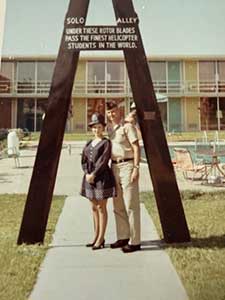
Brandt’s path started in January 1969 with basic training at Ft. Polk, La. In March he transferred to Ft. Wolters, Texas, to begin the six-month long Warrant Officer Candidate (WOC) school, which included helicopter training in the OH-23 Raven. Despite the complexity of helicopter controls, flying came naturally.
Following that initial step, he transferred to Fort Rucker, Ala., for advanced flight and instrument training, where he moved up to the UH-1 helicopter, better known as the “Huey.”
“The 11-month course was intense and we were tested regularly,” he says. “If you didn’t progress like the Army expected, you washed out. Our WOC class started with 300 candidates. At the end, 150 of us graduated with Army Aviator Wings and earned promotion to Warrant Officer-1 (WO1).”
After graduating in February 1970, and enjoying a short leave, Brandt deployed to Vietnam with the 10th Combat Aviation Battalion and was assigned to the 192nd Assault Helicopter Company at LZ Betty near Phan Thiết. The company comprised UH-1C “Charlie” model helicopters – a platoon of gunships, the “Tiger Sharks,” and a “3 slick platoon,” the “Polecats.”
Teaming with the Tiger Sharks, Brandt’s Polecats supported the 3rd Battalion (Airborne) 506th Infantry, inserting troops in the field, delivering supplies, mail, and bringing troops back to base upon completion of their missions. “We worked with their LRRP teams (Long Range Reconnaissance Patrol), supported the MAC-V (Military Assistance Command Vietnam) units, and hauled passengers – military and civilian – from base to base.”
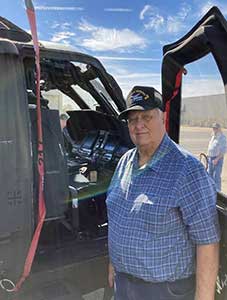
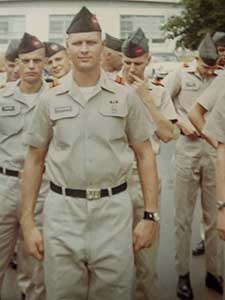
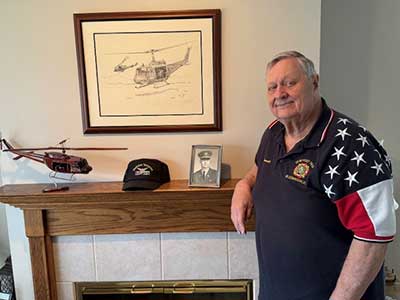
During the first 30 minutes of his first mission, inserting a LRRP team, he came under enemy fire, a jarring introduction to combat. “At the end of that first day of flying I didn’t think I had a chance of making it through a year flying in Vietnam unscathed,” he remembers. Despite this literal baptism by fire, Brandt describes the rest of his tour as fortunate. He operated in a relatively less intense region compared to other areas of the war and only caught fire a handful of times.
Brandt takes special pride in the fact that during 12 months in Vietnam, he logged 1100 hours of flying, completed every one of his missions, and remarkably, never lost a crew member or passenger.
In late September 1970, his company relocated from LZ Betty to Phan Rang Air Force Base in South Vietnam, which offered all the amenities one would find back in the world. “This gave us a chance to work with the Korean White Horse Division and ARVN units that were taking over operations as the U.S. began withdrawing,” he says.
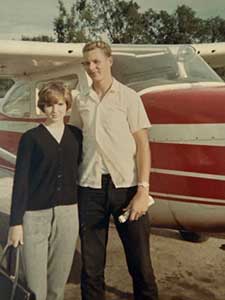
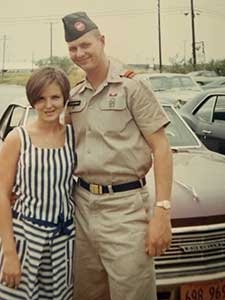
Back home, life continued. He had married his wife, Sandy, in 1968. During his deployment she gave birth to their daughter, Laura. Like many soldiers, he shielded his wife from the dangers he faced.
In early 1971, as the Army reduced troop levels, he returned home, met his eight-month-old daughter and resumed work at TWA. In 1973, Brandt and Sandy bought the house in Bloomingdale where they still live, and one year later, their son, Philip, was born.
Brandt’s aviation career spanned decades of industry upheaval, including layoffs and a later move to United Airlines. It came to an end after the attacks of September 11, 2001, when he lost his airline job. He then began a second career as a fire safety inspector in Bloomingdale, a role he held for more than a decade. He retired in 2014 but remains active as a fire commissioner, VFW member, and devoted family man.
Reflecting on his service, he says, “We were cowboys. The Army gave us helicopters that cost a half million dollars and said: ‘go to it,’ and we did. Years later, I can’t take anything for granted.”
Thank you for your service, Brandt! We hope you enjoy your Honor Flight!