
Army Vietnam War Logansport, IN Flight date: 09/23/26
By Al Konieczka, Honor Flight Chicago Veteran Interview Volunteer
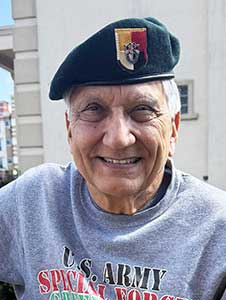
There’s a version of Lenny Corso’s life that fits on an index card: Army medic, Green Beret, Sergeant E-5, Special Forces Group, National Defense Medal, Good Conduct Medal, Parachute Badge, Expert Marksmanship Medal and Presidential Unit Citation. It’s an accurate record. It’s also the smallest version of a much bigger story — one that runs from a one-room schoolhouse in rural Virginia, through a blizzard at Fort Knox, into a jungle warfare course in the North Carolina pines, and out the other side into 40 years of healing and teaching people across Northwest Indiana. Today, at 80 years old, Lenny is still in front of a classroom.
A Big Italian Family and a Shy Kid from Logansport
Lenny grew up in Logansport, Indiana, in a large, devoutly Catholic Italian family — the kind where 2nd and 3rd cousins felt like siblings, and where the parish priest, the convent, and his grandfather’s house all sat within sight of each other. “We couldn’t get away with a lot.“
Lenny’s father had served in World War II — despite having only one eye, the result of childhood cancer — and met Lenny’s mother at a USO dance in Virginia. His mother had grown up with an eighth-grade education, in a one-room schoolhouse without plumbing, in a farming community so remote that none of her siblings had birth certificates.
By his own description, young Lenny was a quiet, undersized kid — 5’6″, 130 pounds — who wasn’t an athlete, wasn’t a class officer, and didn’t stand out. He credits two years at Culver Military Academy during high school summers with two lasting gifts: getting his homesickness out of the way early, and making the rifle team, where his unit finished third in the nation. Both would matter more than he could imagine.
He recalled a comment from a high school history teacher. “So in my senior year, the president of South Vietnam was assassinated in early November and President Kennedy was assassinated late November of 1963. We had a history teacher who said, ‘Guys, you need to pay attention to this wall map here. There’s a place in Southeast Asia called Vietnam, and you’re probably all going there. You’re all going to get drafted if you don’t go to college.’ So, I graduated and tried to go to college.” He enrolled at Indiana State after high school but struggled without the study habits or guidance his classmates from more established families had. After two rough years, he withdrew — not realizing that doing so would cost him his draft deferment. Rather than wait to be assigned an occupation, he enlisted, hoping to choose his own path. Raised on John Wayne films and a deep respect for battlefield medics, he told the recruiter he wanted to be a combat medic. It was, in hindsight, an almost naive decision — but it set the course for everything that followed. “I always had an interest in the human body and I always had a lot of respect for the medics and what they had to do. So I said, I’d like to become a combat medic. Now, the recruiter didn’t say, well, you know, you could be a hospital medic, you could be a dental hygienist, you know, one of the safer ones. He just said, I’ll sign you up right here.”
From the Blizzard of ’67 to the Green Beret
Lenny entered the Army in December 1966 — a detail that mattered more than he realized at the time. Joining in December instead of January placed him on a training timeline that ultimately kept him out of Vietnam, making him what he carefully calls a “Vietnam-era veteran,” not a Vietnam veteran, a distinction he’s precise about to this day.
Basic training at Fort Knox, Kentucky, began in January 1967 — square into the infamous Blizzard of ’67, when snowdrifts reached the barracks windows and the mess hall cooks couldn’t get in to cook for two straight days. “Now, the first day we didn’t mind it, because we loved the extra rack time in basic training, but by the second day, we were starving, and they still couldn’t get it in. Everything’s forbidden in basic training, there’s no card playing, you didn’t have cards, there was nothing, and we were really bored that second day. Thankfully the water fountains didn’t freeze.” What could have broken morale instead gave Lenny his first taste of real accomplishment: thanks to a childhood spent playing ball for hours on end and hauling 400 50-pound bags of potatoes for his father’s fruit and vegetable business, he arrived at basic in far better shape than most recruits. “So I go to basic training and I see all these guys are out of shape. They can’t even do pull ups. Now, my body type back then would have been that of a gymnast. I’m a small guy, but I had good upper body strength. So I’m saying, you got to be kidding me. I keep hearing about how hard basic training is. I mean, I was bored.” He went on to earn the physical fitness trophy in basic training.
From there, the path moved fast: Basic Combat Medic training at Fort Sam Houston, Texas, in the spring of 1967, followed by an invitation to Special Forces. He completed Airborne jump training at Fort Benning, Georgia — enduring 85-degree nights with no window screens — before heading to the John F. Kennedy Special Warfare Center at Fort Bragg for the demanding medical training that would define his service.
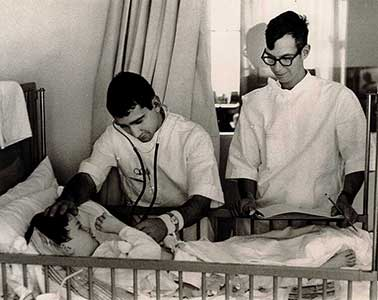
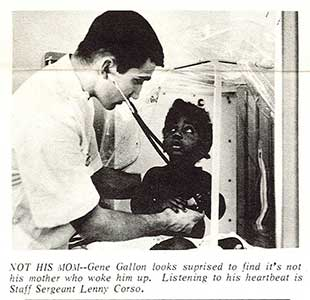
The training was intense and comprehensive: anatomy and physiology classes reached on five-mile runs before breakfast; rotations at Brooke Army Medical Center, where he treated severely burned soldiers; clinical work at Ireland Army Hospital back near his hometown; live-tissue trauma training with animals that he and his fellow medics found emotionally difficult despite its necessity; and finally Robin Sage, the culminating field exercise that included land navigation, evasion, and simulated capture. He earned his Green Beret in July 1968 and was assigned to the 3rd Special Forces Group at Fort Bragg, working extensively in the emergency room at Womack Army Hospital, where he often worked 12 to 18 hour shifts simply because he was learning so much from the rotating physicians. Promoted to Sergeant E-5 in December 1968, he became a senior medic, training other Special Forces soldiers in lifesaving combat medicine.
The Names He Carries
Lenny’s account of this period is inseparable from the friends he lost. A high school classmate, Tom Presoff, was killed by friendly fire in 1967 — a death that made front-page headlines in Logansport’s daily paper. His unit’s Sergeant Major, a respected World War II and Korea veteran, was killed in April 1969 when his helicopter was shot down. A fellow medic, Howard “Howie” Hill, died on a classified SOG mission into Cambodia and Laos — missions so secret that Lenny, despite his own security clearance eligibility, signed a nondisclosure agreement forbidding him from discussing his training for twenty years. “Of course, this was all hush hush. We just knew he was killed. And nobody talked about SOG. And for those SOG guys, it was even worse for them, they all had top secret security clearance and they’re in Cambodia and Laos and we’re not even supposed to be there.” In the United States military, SOG stands for MACV-SOG (Military Assistance Command, Vietnam – Studies and Observations Group), a top-secret special operations unit active from 1964 to 1972.
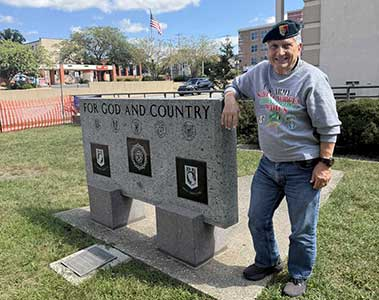
Perhaps the story he tells most carefully involves a high school friend he happened to run into on the street after years apart — a young man about to join the Navy as a cryptology officer, reasoning he’d be safely behind the front lines. Three weeks later, his plane vanished over the South China Sea with no wreckage ever found. Because the deaths weren’t combat-related in the technical sense required, none of the men aboard were listed on the Vietnam Memorial Wall — a distinction Lenny still considers unjust. He and his graduating class honored both men’s families at their 40th high school reunion, framing their original obituaries as keepsakes. Decades later, when Lenny helped build a Veterans’ wall of honor at his old high school, he made sure their names had a place at the top — alongside Humberto Sanchez, a young man from his hometown killed in the 2021 Kabul airport bombing.
Lenny’s own orders for Vietnam finally arrived in November 1968, only to be rescinded weeks later — he had too little service time left to be worth deploying. He spent his remaining months training National Guard medics before the 3rd Special Forces Group was deactivated in December 1969, the same month he completed his military obligation.
College, a Locked Door, and Fifty Years of Marriage
Lenny returned to Indiana State a changed student — focused, disciplined, and determined, carrying full course loads while working twenty-five hours a week. He earned his degree in Health Science in January 1972.
That same fall, a chance encounter changed his life. Walking into a campus building to see his advisor, he passed a young woman. He was certain he recognized her from a shared class. He didn’t — but he played along anyway, and the bluff turned into a dinner invitation, a shared laugh, and, eventually, fifty-one years of marriage to Sandy Corso, a state champion swimmer from Southport High School whose family had its own remarkable story of resilience. “I didn’t think we were in a class together but she got indignant and said, ‘Yes, we were.’ It had been probably about 1 ½ years since we were in class together. She said she wore peach colored sweatshirt, and then I remembered some girl who wore a peach shirt. But when she was swimming and her hair was very short. When I saw her that day, her hair was very long. So she corrected me and for 51 years she kept correcting me.”
They married in April 1973 — deliberately avoiding a March wedding date so their anniversary wouldn’t forever compete with March Madness. The couple raised two daughters, both IU graduates who went on to successful careers, one as a bank executive in Houston and one as an audiovisual technician in Maryland.
Forty Years Healing, Then Teaching
Lenny’s post-military career mirrored the discipline of his service. He worked as a health educator, then trained as a Physician Assistant through Indiana University’s PA program. He was part of one of the program’s earliest graduating classes, at a time when he likes to joke, most people assumed “PA” meant “public address announcer.” He and Sandy agreed to delay having kids until she completed her master’s degree, and he later earned his own master’s in human physiology, funded in large part by the GI Bill, which covered five of his seven years of college.
He spent a decade as a PA in occupational medicine, followed by 19 years in pharmaceutical sales. At 60, with his mortgage paid off and his daughters through college, he made a deliberate career change — pursuing a longtime goal of teaching. He joined Ivy Tech Community College, where he is now starting his 20th year teaching advanced physiology to nursing students.
His classroom reputation is, by his own account and his students’, legendary. Known to generations of nursing students as “Professor Rambo,” Lenny built a rigorous, homework-heavy curriculum designed to instill discipline as much as knowledge. Students who complete his course are said to have “earned their tiger stripes” — a nod to the tiger memorabilia that fills his office and the nickname he gives his students: Tiger Cubs. He maintains a Facebook alumni network of more than 675 former students, many of whom now work throughout NW Indiana’s hospital system, and he’s known to take his entire class out to dinner at the end of each term.
Still Serving
Retirement, for Lenny, has never meant stepping back. He’s a 31-year member of the Kiwanis Club, where he helps organize the community’s annual Veterans Appreciation Dinner — an event that reliably sells out at 580 attendees and honors roughly 220 local veterans by name and branch of service.
Lenny’s wife Sandy passed away in 2024 after a series of health complications that began with unexpected open-heart surgery in 2011, despite a lifetime of good health and no apparent risk factors. Even amid that loss, he has kept moving forward: renovating the home they shared, training with a personal trainer at the YMCA, and walking into his classroom each semester ready to push a new group of students toward their own tiger stripes.
From a five-foot-six kid who couldn’t make the basketball team to a Green Beret medic, a physician assistant, and a professor who has now taught more than a thousand students, Lenny Corso’s story is, in the end, a story about showing up — for his country, for his patients, for his family, and for decades of students who walked into his classroom nervous and walked out, as he’d put it, having earned it.
Lenny, thank you very much for your dedicated service. Please enjoy your well-deserved trip to Washington D.C.!