
Air Force Vietnam War Era Skokie, IL Flight date: 10/28/26
By Wendy L. Ellis, Honor Flight Chicago Veteran Interview Volunteer
Never underestimate the power of a simple postcard. In 1971, a postcard stamp cost 6 cents, but the postcard Catherine Lick received that year probably didn’t even have a stamp on it. It was from the United States Air Force and it asked a simple question. How would you like to be an Air Force nurse?
“I was working at a local hospital in Lansing by Michigan State, where I graduated. Everybody I worked with was middle age, married with kids, and I was 23 years old and I got this post card that said would you be interested in Air Force nursing? And the commitment was only two years because they needed nurses so bad because of Vietnam. I thought, two years, what have I got to lose?”
Nurses, especially those with college degrees, had a choice of where they wanted to serve. She never even considered that she might be sent to Vietnam because Army nurses were serving in theater over there. So she had three choices- Chanute AFB in Rantoul, IL, which she figured was out in a corn field, Frances E. Warren, in Cheyenne, Wyoming, which was even farther out in the wilderness to her, and Wright Patterson AFB near Dayton, Ohio. “I joined the Air Force to see the world and I ended up 325 miles down I-75 at Wright Patterson AFB.”
Initially she served as a flight nurse, greeting incoming aircraft carrying wounded soldiers from Vietnam, day and night, 7 days a week. “Vietnam was a real change from how care was provided. They could get them out so fast. The helicopters would land right on the battlefield, they’d take the wounded in. They’d go to like a MASH unit, get stabilized and then fly to Clark in the Philippines. Or to Japan.” Because Wright Patterson was a huge medical facility for the whole north central United States, any soldiers from this area, would finally come to them, but not after a circuitous route home.
“They’d come to us on a litter with a manila envelope with every place they’d landed,” says Lick. “They’d come in a pair of pajamas and an Army blanket and they’d be freezing because Vietnam was so tropical.” Her first year, Lick worked in a surgical unit, but transferred to a psychiatric unit the second year. “One guy I remember in particular, an 18-year-old from Kentucky. I don’t know if he’d ever been out of his county before. Then to be sent to Vietnam and to see all that, and the drugs, and just come back a mess. It was sad.”
While there were many obstacles for women in the military back then, getting promoted wasn’t an issue for Lick. Commissioned as a Second Lieutenant in November 1971, she was promoted to First Lieutenant three months later, and to Captain 18 months after that. While most serving nurses had a three-year diploma from a hospital, Lick had a Bachelor’s Degree in nursing, something that smoothed the way for her move up the ladder.
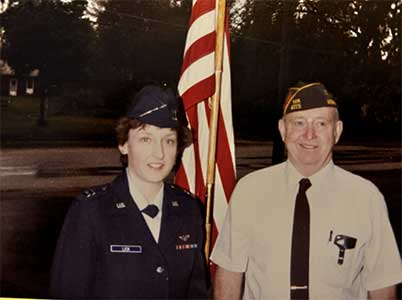
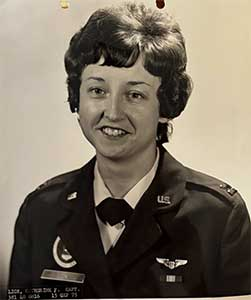
Her personal life began to take shape in 1975, when she married her husband, Myron, and decided she needed to be closer to him in Detroit. She applied to a recruiting position with the Air Force Reserve at Selfridge Air National Guard Base in Mount Clemens, Michigan, north of Detroit. She was still active duty but when she got the job and became the Nurse Recruiter for the state of Michigan, she resigned from active duty and joined the Air Force Reserve, which became her military home for the next 25 years. At the time she didn’t know the difference between the Reserves and the National Guard. “But I knew the Guard was under the auspices of the Governor and the guard got called up for the riots in Detroit so I joined the Reserve.” says Lick.
She went into the Air Force Reserve medical evacuation squadron as a flight nurse, since she already had the training. Give them one weekend a month and fly two nights a month to stay current. Sounds easy, unless you’re a woman. “In 1976 the regulation ended that you got discharged if you were pregnant, so I got pregnant in 1977. I was the first person in my unit not to get discharged for being pregnant,“ says Lick. “They didn’t have maternity uniforms back then. I had a blue top so that’s what I wore and I came to sign in that morning and the first sergeant says excuse me ma’am you can’t sign in because you’re not in uniform. And I said, Excuse me Sergeant, this IS my Uniform.” That was ’77-’78 and by the time I had my son in ’81 they had a maternity uniform.
That was also the year regulations changed again, requiring her to work several days a month as a nurse, which she didn’t want to do while pregnant with her second child. She left her position as a flight nurse and became a line Officer in the Reserve as Chief of Personnel. She was also teaching Equal Opportunity-everything from Women’s rights to the Buffalo Soldiers and the Tuskegee Airmen-and dealing with Drugs and Alcohol, something her nursing training definitely helped with. All of the various jobs she held required training that she found helpful as the years went on. “God never wastes an experience,” says Lick.
That could not have been more true in 1990, when 300 members of the Reserve unit at Selfridge were called to active duty in Desert Shield. “The Reserves hadn’t been deployed since the Korean War, maybe the 1950’s?” Says Lick. “There was no family support in the Reserves so I became the family support officer.” It was a job she and her unit had to create from scratch. Are your emergency contacts up to date? Are your shots up to date? Does your family have health insurance? Will your income change? In the Reserves enlisted members didn’t have to retire until age 60. “There were grandpas being deployed, there were single parents,” says Lick. “Who would take your child if you got deployed? Well, they never thought that was going to happen. A lot of times that was the grandma and grandpa. So all of a sudden here’s this 68- or 70-year-old with a 3-year-old to take care of. Families hadn’t experienced this before.” The reservists were deployed to the United Arab Emirates flying cargo planes from September of 1990 to February of 1991. Lick worked full time during the deployment holding weekly meetings and answering a myriad of questions. Every time a plane went down they would get worried phone calls. But it was never their planes and in the end, all 300 reservists came home safely.
All of that experience helped Lick take on a civilian job as Parish Nurse in her home county, where she started a Parish Nursing network. Still a reservist, a new commander removed her from her job as Squadron Commander with the 927th, so she called upon her recruiting skills from years before, and became Air Force Academy and ROTC Liaison Officer, recruiting and interviewing high school grads who wanted to go to the Air Force Academy. She was promoted to Colonel, and when a new Commander arrived at Selfridge in the late ’90s, he asked her to come back and be his Inspector General.
“It was the cherry on top of the sundae,” says Lick. “I’d had my whole career, and the last two years were in my original unit as Inspector General. Then I retired.”
She and her husband have lived the last five years in Skokie to be near her grandchildren. She says it was the relationships she made along the way that made her experience worthwhile, but it was her father who made her want to see the World War II Memorial in Washington DC with Honor Flight Chicago.
“My dad was a WWII combat veteran in Italy and he was always really upset that there was a Vietnam memorial, that there was a Korean memorial, but there was not a WWII memorial,” says Lick. ”As commander of the local American Legion post he was real involved. He raised money and really pushed to get that WWII Memorial, which he never saw. So that’s my real motivation to go, for my dad.”