
Marines Vietnam War Olympia Fields, IL Flight date: 04/15/26
By Ginny Williamson, Honor Flight Chicago Veteran Interview Volunteer
Michael Granberry was born at Cook County Hospital in Chicago in 1947. He lived with his parents Early Granberry and Ruth Easter Granberry and 10 siblings in Chicago until Michael was in the 2nd or 3rd grade. His father bought a house in Gary, Indiana and Michael lived there until he was in the 7th grade. He moved back to Chicago to live with an aunt until he moved back to Gary in the 8th grade. After moving back to Chicago again, this time with the whole family, Michael graduated from Englewood High School in 1966.
After high school, in 1966, Michael and his friend Warren Banks enlisted with the Marines on the Buddy Plan. The Buddy Plan was set up for friends to go into the Marines at the same time and would go to boot camp together. So, Michael and Warren opted for that.
Michael spent the first eight weeks of boot camp and training at Marine Corps Recruit Depot in San Diego, California and then two weeks of BIS (Basic Infantry Service training) at Camp Pendleton, California. Before being deployed, he was able to go home for one month.
Michael was transported with about 2,000 other Marines to Vietnam on the USS Upshur. The Marines were shipped without any rifles or ammunition. During their transport to Vietnam, the ship picked up approximately 3,000 Army soldiers in California; they were fully equipped with weaponry – rifles, ammunition, etc.
Michael arrived in Vietnam in February 1967. He served in Vietnam during the Tet Offensive which started in January 1968. When they arrived to Vietnam, they took boats to the shores of Da Nang, then on to his home base in Dong Ha – still with no weapons. They finally got their weapons when they arrived at their home base. Their unit was named “Fighting Mad Kilo 3/3”, part of the 3rd Marine Division Fleet – Marine Force.
Michael’s enlistment code was an MOS 0311, also known as Grunt Rifleman / Ground Pounder. The riflemen are the heart of the Marine Corps. His unit was sent out on “Search and Destroy Missions” right away. Michael went to Hill 867, where he pulled injured / dead Marines out of the area while active combat was taking place. Michael’s platoon was sent to Hill 867 to join the Marines already engaged in active battle. His platoon engaged in fierce fighting. As his platoon started backing away from the active line of fire, they retrieved injured / dead Marines from the combat area. They had to drag Marines away from the line of fire on their hands and knees. Unit 3-6 had to leave their ships to assist Michael’s unit to get off the hill. The battle lasted approximately two days.
They lost quite a few men and eventually had many recruits sent in to replace those that were lost or wounded. Michael recalled that they were in many fire fights while in Vietnam and continued to lose more men. “All you could do was move on; you could not really think about what was happening.” He said if your mind started to wander, you could become a casualty yourself. He said it was all about the camaraderie of the brotherhood. “Either you live together or die together.”
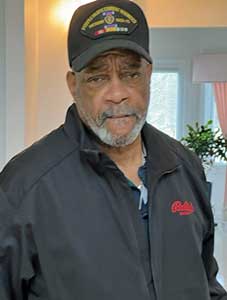
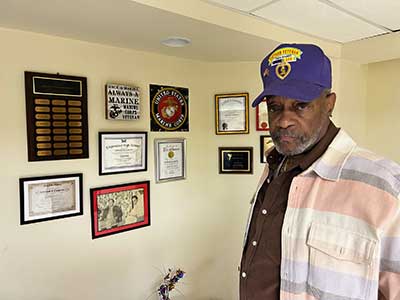
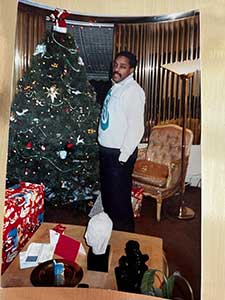
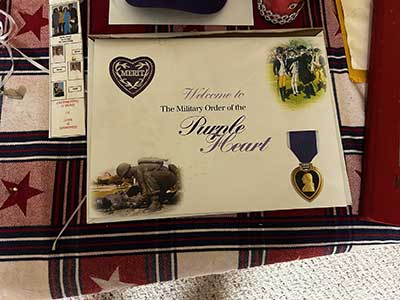
On February 7,1968, that was put to the test. This is the morning that Michael was severely injured when he was out on a mine sweep search. They were told that there was a regiment of North Vietnamese about three miles away, so they were not too concerned. Before being sent out on the search and security mission, Michael was in his bunker and was playing cards with his fellow Marines. (He won $900 that night.)
Michael was the 2nd Platoon squad leader, with mine sweepers on the road. Michael was in a clear field and he heard a lot of noise on the radio. He knew that the 1st and 2nd Platoons were going to move into the vegetation (forest area) where the 3rd and 4th Platoons were engaged in fire-fighting. That is when they took fire.
The whole squad was on the line and was taking fire. Michael recalls that his radioman was on his right side and his M79, Willie was on his left side; the gunner was also on his right side.
As they were moving through the thicket, they ran into a long ditch as they began receiving fire from all angles. Michael recalls seeing the North Vietnamese jumping from one bush to another bush. Michael told Willie to fire a grenade into the area from where the shooting was coming. When Willie leaned forward, he was shot in the back of his body. Willie told Michael to pull him from the line of fire because he was unable to move himself. So, Michael pulled him from the line of fire.
During the combat, Michael heard some of the men in front of the squad moving laterally. Then, when Michael took position, he was shot in the back right shoulder. He was out for several hours and when he regained awareness, he had fallen on his left arm extended. When Michael regained consciousness, he realized he had been shot in the posterior area of the right shoulder. He was barely breathing; his breathing was very shallow.
Michael felt a presence staring at him. He felt the presence jump into the trench, and he felt him continue to stare at him. The person then laid his rifle across Michael’s back, then he pulled Michael’s rifle from under him and took his cartridges and a map from his pocket. On his right side, the person took the grenades that Michael had on him. Michael could still feel the person staring at him. Then the person took his rifle from Michael’s back, climbed out of the trench and left.
Michael heard movement again. This time, someone felt for Michael’s pulse and announced, “Corporal Granberry is alive.” It was Corpsman Allan B. Doc Sams. Michael explained to Corpsman Sams what happened to Willie, that while he was pulling Willie down out of the line of fire, that was when he was hit also.
Michael, Corpsman Sams and another Marine who had been shot twice (nicknamed Rat) could hear his Marine company moving toward them. It was getting dark, but they could still hear the North Vietnamese moving around them. Michael told Corpsman Sams to use their grenades if they had to.
It was several hours before Michael heard a helicopter in the area. He told Corpsman Sams to wave a rag on the ground to signal the helicopter. Then the helicopter crew gave the OK sign. They could still hear the firing in the background of the helicopter. The helicopter was shooting around them. Michael and the others stayed in the trenches while the shooters were clearing the area of North Vietnamese soldiers. They could still hear movement in the area.
Night approached and Michael did not hear the rest of his company approaching anymore. They assumed the company had dug in for the night.
At daybreak on February 8th, Michael saw the tracers and he knew his company was moving in to rescue them. A tank pulled up next to them and a guy that Michael went to high school with – Dino LaFeat – was in the tank. LaFeat saw Michael laying in the trench and observed Michael looking at him and stated that “Michael Granberry is alive.”
After his rescue, Michael stayed at a medical unit at the Phu Bia Combat Base for three days. From there he was moved to the Cam Ranh Base where he stayed for seven days, and then to Yokosuka, Japan for an hour before being sent back to the U.S.
Michael told them he wanted to go to the US Naval Hospital in Great Lakes, north of Chicago, but Great Lakes was overcrowded at that time. So, he went to the US Naval Hospital in California. He was there for 30 days before he was released and sent home on leave.
After returning from Vietnam and recovering from his wounds, Michael’s last station was in North Carolina, at Camp Lejeune. There he was a tactical instructor through 1969. And from 1969 to 1972, he was in non-combat service.
In November 1969, he began working at the Juvenile Temporary Detention Center (also known as JTDC, previously known as the Audy home) in Chicago. He watched over the residents there, and provided discipline. For the first 19 years at JTDC, Michael worked the midnight shift and then was transferred to the day shift. There he was promoted from supervisor to manager. He worked the rest of his 19 years on the day shift. Michael retired in 2007 after a total of 38 years.
The JTDC was around the corner from the Veteran’s Administration building. Because of his injury in Vietnam, Michael was eligible for benefits. With those benefits, he was able to attend Malcolm X College working towards a Liberal Arts degree. However, he never got his degree. When the military stopped paying him, unfortunately Michael stopped going to Malcolm X College.
Michael met his current wife, Shirley, while he worked at the Juvenile Temporary Detention Center. Shirley worked for CPS (Chicago Public Schools). Together they have six children and seven grandchildren. The grandchildren all live in the area with the exception of one who lives in North Carolina. So, Michael spends a lot of time being the best granddad he can be. As Michael says, “I am blessed and highly favored.”
These days Michael spends much of his time going to meetings at the Disabled Veterans’ PTSD group every week. He is also the company commander of the Disabled American Veterans (DAV) location in Chicago and attends meetings there once a month.
Michael also goes to Washington, D.C. every year with the DAV to lobby for improvement of veterans’ services. He also goes to the DAV Summer Convention in August each year to petition for upgrades or improvements. With the DAV, he said you can plead your case and if you are needing care, you can get it there. The DAV also helped to petition for increased spousal benefits. Today, military spouses receive 40% of benefits while federal worker spouses receive 50% of benefits. With the DAV, they are working to increase the military spouse benefits.
For his service, Michael received the Vietnam Service Medal, the Vietnam Campaign Medal, the Purple Heart, the Combat Infantryman’s Badge, a Presidential Unit Citation, and a Marksman Rifleman’s Badge. One medal that Michael did not receive but feels he earned was the Vietnam Tet Offensive Commemorative Medal, which honored U.S. military personnel who served during the Tet Offensive in 1968. But, “I’m not going to go into that.”
Michael shared that he had some very, very bad times in Vietnam, but some the best times as well. There was a lot of love. “That was my family.”
Michael is proud of what he did. “Each and every individual who went to Vietnam has a story to tell; it needs to be known.”
Welcome aboard, Michael. Enjoy your day of honor. And thank you so very much for your years of service.